Full Access Link Bible Reveals Hidden Sex Teachings
The phrase "Full Access Link" in biblical discourse often sparks curiosity about its deeper spiritual and ethical implications, particularly when intertwined with teachings on human sexuality. While modern interpretations frequently reduce sacred texts to rigid moral codes, the Bible presents a complex tapestry of metaphors, cultural contexts, and evolving theological perspectives. Beyond surface-level debates on purity or prohibition, passages like Genesis 2:24 and the Song of Solomon offer nuanced explorations of intimacy as both a divine gift and a sacred trust, challenging readers to distinguish between literal commands and symbolic truths.
Historical and linguistic analyses further complicate these discussions, revealing how ancient Near Eastern traditions shaped biblical views on access, consent, and sacred knowledge. From the restricted entry of the Temple in Jerusalem to the allegorical debates surrounding the Song of Solomon, the Bible’s stance on sexuality is not monolithic but reflects layers of cultural, theological, and interpretive evolution. This exploration dives into how translations, historical events, and modern movements—from Puritanism to feminist theology—have reshaped understandings of "access," exposing both continuity and conflict within Christian sexual ethics.
Understanding the Term "Full Access Link" in a Biblical Context: Sacred Boundaries, Spiritual Connections, and Divine Intimacy

The phrase "Full Access Link"—when examined through a biblical lens—invites exploration into themes of restriction, permission, and sacred knowledge, as well as the metaphorical and literal dimensions of intimacy within religious texts. While the term itself is not explicitly mentioned in Scripture, its conceptual framework emerges from passages addressing divine access, marital covenants, spiritual authority, and the boundaries between the sacred and profane. This discussion dissects how ancient Near Eastern traditions, priestly roles, and covenantal relationships shaped the biblical understanding of "access," while also clarifying how modern interpretations may conflate literal and metaphorical applications—particularly in discussions surrounding human relationships, divine revelation, and moral conduct.
Conceptual Foundations: "Access" in Biblical and Ancient Near Eastern Traditions

The idea of "access" in the Bible is deeply rooted in the cultural and religious practices of the ancient Near East, where sacred spaces, rituals, and knowledge were tightly controlled to preserve holiness and prevent misuse. Temples, for instance, were not merely places of worship but symbolic representations of divine presence, and entry was restricted to priests or designated individuals. This concept of controlled access extended to knowledge—certain teachings, prophecies, or divine mysteries were reserved for those deemed spiritually prepared. The biblical narrative reflects these traditions, particularly in stories where characters like Moses, Aaron, and later Jesus, are granted special access to divine truth or presence, often accompanied by strict parameters.
In Hebrew, the term "derek" (דרך), meaning "way," "path," or "access," frequently appears in contexts describing entry into divine favor, covenantal relationships, or moral conduct. For example, Proverbs 4:11 states:
"I have taught you the way of wisdom; I have led you in the paths of uprightness. When you walk, your steps will not be hampered; when you run, you will not stumble."
Here, "paths" (derek) symbolize the spiritual access granted to those who follow divine instruction. Similarly, "shalom" (שָׁלוֹם), often translated as "peace," also carries connotations of uninterrupted access—a restored relationship with God, free from barriers of sin or separation.
Table of Contents
- Understanding the Term "Full Access Link" in a Biblical Context: Sacred Boundaries, Spiritual Connections, and Divine Intimacy
- Conceptual Foundations: "Access" in Biblical and Ancient Near Eastern Traditions
- Biblical Passages on Access: Divine Permission and Moral Boundaries
- Comparative Analysis: Translational Variations in "Access" Terminology
- Biblical Passages on Sex and Intimacy: A Thematic Exploration of Sacred Texts
- Ten Biblical Verses on Human Sexuality, Categorized by Thematic Focus
- Song of Solomon: Allegory or Celebration of Human Intimacy?
- Theological Perspectives on Sex: Puritanism, Liberalism, and Modern Reinterpretations of Biblical Intimacy
- Puritanism’s Austere Vision: Sex as Duty, Not Desire
- Conservative vs. Liberal Christian Interpretations: A Clash of Ethical Boundaries
- Feminist Theology’s Reclamation: Challenging Patriarchal "Access" in Scripture
- Sex-Positive Christianity: Redefining Intimacy Beyond Guilt
- Cultural Shifts and Their Impact on Christian Sexual Ethics
The Greek New Testament further elaborates on access through terms like "prosklisis" (προσκλῆσις), meaning "access" or "approach," used in Ephesians 2:18 to describe believers’ unity through Christ:
"For through him we both have access by one Spirit to the Father."
This passage underscores the spiritual privilege granted to followers of Christ, contrasting with the restricted access in the Old Testament temple system.
Biblical Passages on Access: Divine Permission and Moral Boundaries
The Bible presents access as both a privilege and a responsibility, often tied to covenants, obedience, or divine appointment. Below are key passages categorized by their thematic focus:
### 1. Access to Divine Presence and Knowledge These texts highlight exclusive or conditional access to God’s presence, wisdom, or prophetic revelation. - Exodus 3:5 – Moses’ encounter with the burning bush illustrates restricted access to the divine:
"Do not come any closer! Remove the sandals from your feet, for the place where you are standing is holy ground."
The command to remove sandals symbolizes preparation and reverence before approaching holiness.
- Numbers 18:7 – Priestly access to sacred duties:
"You and your sons are to guard your priestly responsibilities with regard to everything connected with the altar and behind the curtain, and you are to serve. I am giving you the priesthood as a gift on behalf of the Israelites, but you must give a gift to the Levites in return."
This passage defines hierarchical access, where Levites manage temple logistics but priests alone perform sacred rites.
- 1 Corinthians 2:10-12 – The Spirit’s role in revealing divine mysteries:
"These are the things God has revealed to us by his Spirit. The Spirit searches all things, even the deep things of God. For who knows a person’s thoughts except their own spirit within them? In the same way, no one knows the thoughts of God except the Spirit of God. What we have received is not the spirit of the world, but the Spirit who is from God, so that we may understand what God has freely given us."
Here, "access" is granted through the Holy Spirit, emphasizing divine initiative in disclosure.
### 2. Access in Marital and Covenantal Relationships The Bible frames marital intimacy as a sacred covenant, where access is both a gift and a symbol of unity. - Genesis 2:24 – The oneness of marriage as divine design:
"That is why a man leaves his father and mother and is united to his wife, and they become one flesh."
The phrase "one flesh" implies mutual access—physical, emotional, and spiritual—within the boundaries of the covenant.
- Malachi 2:14 – Warning against breaking covenantal access:
"You ask, ‘Why?’ Because the Lord is acting as a witness between you and the wife of your youth. You have been unfaithful to her, though she is your partner, the wife of your marriage covenant."
This passage links infidelity to the violation of sacred access, disrupting the divine order.
### 3. Access as a Symbol of Spiritual Authority Jesus’ teachings frequently use "access" metaphors to describe salvation, discipleship, and the Kingdom of God. - Matthew 7:21-23 – False access and divine judgment:
"Not everyone who says to me, ‘Lord, Lord,’ will enter the kingdom of heaven, but only those who do the will of my Father who is in heaven. Many will say to me on that day, ‘Lord, Lord, did we not prophesy in your name and in your name drive out demons and in your name perform many miracles?’ Then I will tell them plainly, ‘I never knew you. Away from me, you evildoers!’"
Here, "access" is conditional—authentic relationship with Christ, not mere religious activity, grants entry.
- John 14:6 – Jesus as the sole path to divine access:
"Jesus answered, ‘I am the way and the truth and the life. No one comes to the Father except through me.’"
This statement redefines "access" as exclusive yet inclusive—mediated through Christ.
Comparative Analysis: Translational Variations in "Access" Terminology
The phrasing of "access" or related terms varies significantly across biblical translations, influencing interpretive nuances. Below is a comparative table of three major translations—King James Version (KJV), New International Version (NIV), and English Standard Version (ESV)—focusing on passages where "access," "entrance," or "permission" plays a key role.
| Scripture Reference | KJV (1611) | NIV (1984) | ESV (2001) | Key Interpretive Shift |
|---|---|---|---|---|
| Ephesians 2:18 | "For through him we both have access by one Spirit unto the Father." | "For through him we both have access to the Father by one Spirit." | "For through him we both have access in one Spirit to the Father." | NIV/ESV soften "by one Spirit" to "through him," emphasizing Christ’s mediatorial role. |
| Hebrews 10:19-20 | "Having therefore, brethren, boldness to enter into the holiest by the blood of Jesus." | "Therefore, brothers and sisters, since we have confidence to enter the Most Holy Place by the blood of Jesus." | "Therefore, brothers, since we have confidence to enter the Most Holy Place by the blood of Jesus." | KJV’s "boldness" vs. NIV/ESV’s "confidence" shifts focus from audacity to assurance. |
| 2 Corinthians 3:12 | "Seeing then that we have such hope, we use great plainness of speech." (Context: "access" to spiritual liberty) | *"Since we have such a hope, we are |
Biblical Passages on Sex and Intimacy: A Thematic Exploration of Sacred Texts
The Bible presents a multifaceted view of human sexuality, weaving together themes of divine creation, marital sanctity, moral boundaries, and spiritual devotion. From the intimate union of Adam and Eve in Eden to the poetic dialogues of the Song of Solomon, sacred texts address sexuality with both reverence and caution. These passages, often layered with cultural and historical contexts, shape theological discourse on intimacy, ethics, and the sacredness of the human body. Understanding these verses—whether explicitly discussing physical acts or implicitly reflecting on relational dynamics—reveals how biblical authors framed sexuality as a reflection of divine order, a covenant between partners, or a battleground for spiritual purity. Below, a curated examination of key passages, linguistic nuances, and interpretive debates illuminates the complexity of biblical sexuality, offering insights into its enduring influence on ethical, theological, and interpersonal understandings of "full access" in relationships.
Ten Biblical Verses on Human Sexuality, Categorized by Thematic Focus
The Bible’s discussion of sexuality spans creation narratives, marital laws, poetic metaphors, and apostolic exhortations, each serving distinct theological purposes. Below, ten foundational verses are categorized by theme to highlight their contextual and doctrinal significance.
Creation and Divine Design The origins of sexuality are tied to God’s creative act, establishing its purpose within the framework of human identity and relationship.
-
"Then God said, ‘Let us make humankind in our image, according to our likeness... Male and female he created them.’" — Genesis 1:27
This verse grounds human sexuality in the imago Dei (image of God), suggesting that gender differentiation reflects divine attributes such as relationality, creativity, and covenantal fidelity. The Hebrew term zarah (זָרַע), used for "male and female," also carries connotations of sowing or planting, subtly linking procreation to divine stewardship of creation. -
"That is why a man leaves his father and mother and is united to his wife, and they become one flesh." — Genesis 2:24
The phrase "one flesh" (basar echad, בָּשָׂר אֶחָד) emphasizes the profound unity achieved through marital intimacy, a bond that transcends physical union to symbolize spiritual and emotional oneness. This verse is frequently cited in discussions of marriage as a microcosm of divine-human relationship.
Marriage and Covenant Marriage is depicted as a sacred covenant, mirroring God’s relationship with Israel and reflecting the seriousness of sexual commitment.
-
"Therefore a man shall leave his father and his mother and hold fast to his wife, and they shall become one flesh." — Ephesians 5:31 (quoting Genesis 2:24)
Paul’s citation in Ephesians frames marriage as a spiritual mystery (musterion), suggesting that the union of husband and wife prefigures Christ’s relationship with the Church. The term episkedein (ἐπισκέδην, "hold fast") implies enduring loyalty, reinforcing the idea of marital intimacy as a lifelong covenant. -
"Do not deprive one another, except perhaps by agreement for a limited time, that you may devote yourselves to prayer; but then come together again, so that Satan may not tempt you because of your lack of self-control." — 1 Corinthians 7:5
This passage addresses the mutual obligation of spouses to fulfill each other’s physical needs, framing sexual intimacy as a means of resisting temptation and maintaining spiritual discipline. The warning against "lack of self-control" (akrasia, ἀκρασία) connects sexual ethics to broader themes of discipline and holiness.
Procreation and Blessing Sexuality is linked to the continuation of human life and divine blessing, particularly in patriarchal narratives.
-
"Now Adam knew Eve his wife, and she conceived and bore Cain, saying, ‘I have gotten a man with the help of the Lord.’" — Genesis 4:1
The verb yada (יָדַע), translated as "knew," carries rich connotations beyond physical intimacy, including cognitive or experiential understanding. Here, it signifies the fulfillment of the creative mandate to "be fruitful and multiply" (Genesis 1:28), positioning procreation as a divine commission. -
"Children are a heritage from the Lord, offspring a reward from him." — Psalm 127:3
This verse elevates children to the status of divine gifts, framing parenthood as a sacred responsibility. The Hebrew nachalah (נַחֲלָה), "heritage," suggests that offspring are both a blessing and a legacy, reinforcing the moral and spiritual weight of sexual union.
Purity and Holiness Sexual ethics are tied to ritual purity, moral conduct, and separation from idolatry or exploitation.
-
"You shall not lie with a male as with a woman; it is an abomination." — Leviticus 18:22
This verse, part of the Holiness Code, prohibits same-sex relations within a broader context of sexual purity laws designed to maintain Israel’s distinct identity. The term to’evah (תּוֹעֵבָה), "abomination," denotes something ceremonially unclean, reflecting the cultural taboos of the time. -
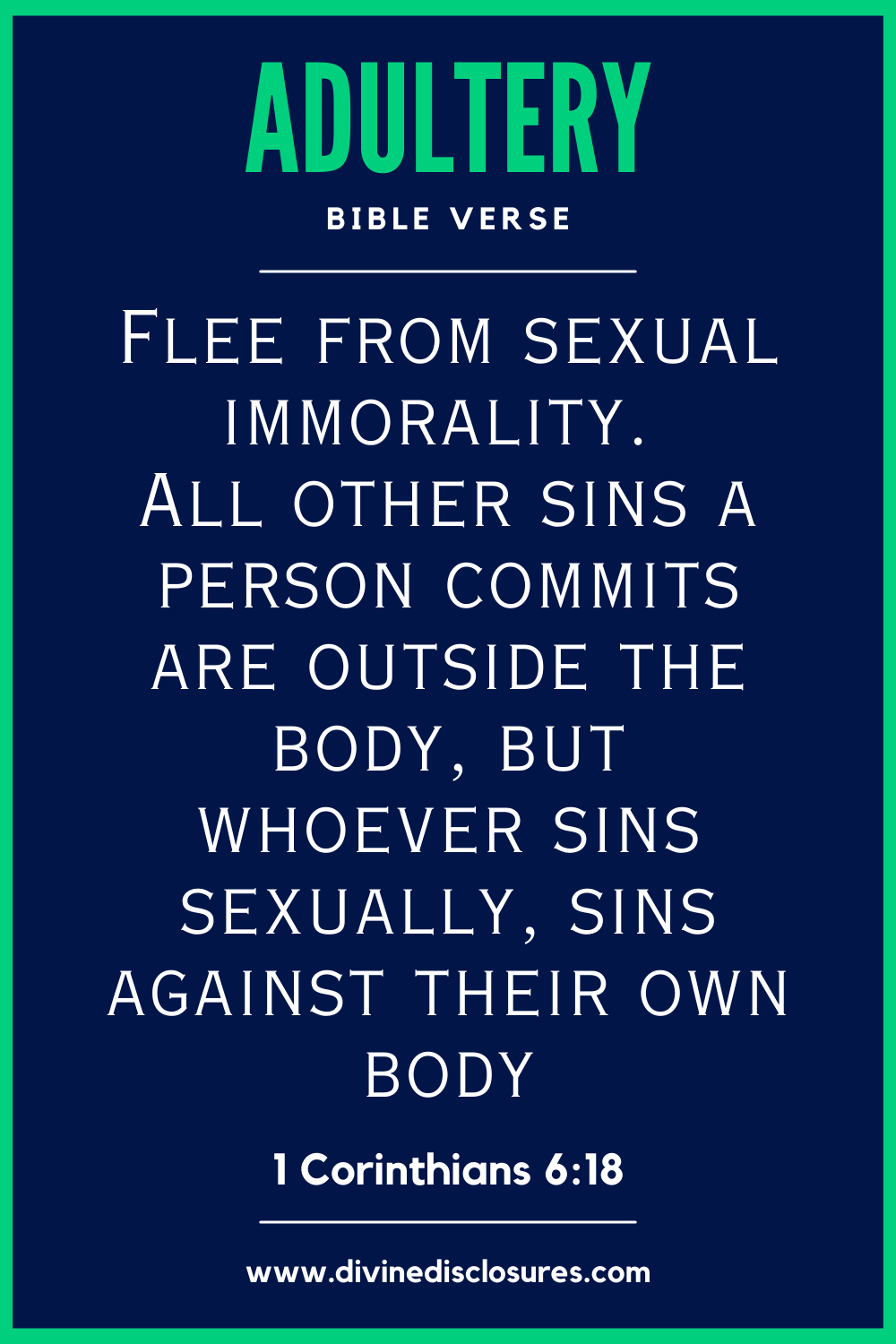
"Flee from sexual immorality. Every other sin a person commits is outside the body, but those who sin sexually, sin against their own bodies." — 1 Corinthians 6:18
Paul’s exhortation frames sexual sin as a violation of the body’s sacredness, a concept rooted in the belief that the body is a temple of the Holy Spirit (1 Corinthians 6:19). The Greek porneia (πορνεία) encompasses a range of sexual transgressions, including adultery, prostitution, and exploitative relationships.
Temptation and Moral Danger Sexual desire is acknowledged as a potential source of sin, requiring vigilance and divine grace.
-
"But I say to you that everyone who looks at a woman with lustful intent has already committed adultery with her in his heart." — Matthew 5:28
Jesus’ teaching in the Sermon on the Mount elevates lust (epithymia, ἐπιθυμία) to the level of adultery, emphasizing the moral corruption of unchecked desire. This radical stance challenges legalistic interpretations, focusing instead on the interior life. -
"For this is the will of God, your sanctification: that you abstain from fornication; that each one of you know how to control his own body in holiness and honor." — 1 Thessalonians 4:3-4
Paul’s instruction to "control his own body" (krateo, κράτεω) reflects Stoic and Jewish ethical traditions, urging self-mastery as a pathway to holiness. The term hagnosyne (ἁγνοσύνη), "holiness," links sexual ethics to broader spiritual discipline.
Song of Solomon: Allegory or Celebration of Human Intimacy?
The Song of Solomon (or Song of Songs) stands as the Bible’s most explicit celebration of erotic love, yet its interpretation has sparked centuries of debate. Some traditions, particularly in the medieval period, read it as an allegory of Christ’s love for the Church or the soul’s longing for God. Others, especially in modern scholarship, view it as a straightforward ode to human marital intimacy, offering a counterbalance to the Bible’s often austere depictions of sexuality.
Historical Interpretations
-
Allegorical Tradition: Early Jewish and Christian commentators, including Philo and Augustine, interpreted the Song as a metaphor for divine love. The "beloved" became Christ or the individual believer, while the "lover" represented God or the Church. This approach aligned with cultural sensibilities that often associated physical desire with moral danger.
Theological Perspectives on Sex: Puritanism, Liberalism, and Modern Reinterpretations of Biblical Intimacy
The Bible’s teachings on sexuality have long been a battleground of interpretation, reflecting broader theological, cultural, and social shifts within Christianity. From the rigid asceticism of Puritanism to the progressive reinterpretations of feminist and sex-positive theologians, the concept of "full access"—whether literal, metaphorical, or ethical—has evolved alongside changing understandings of marriage, consent, and human desire. This section explores how historical and contemporary Christian traditions have framed biblical sexuality, dissecting the tensions between conservative restraint, liberal freedom, and emerging paradigms that seek to reconcile divine authority with human flourishing.Puritanism’s Austere Vision: Sex as Duty, Not Desire
Puritan theology, rooted in the Reformation’s emphasis on strict biblical obedience, viewed sexuality as a divinely ordained duty within marriage rather than a source of personal or spiritual fulfillment. Figures like John Calvin and Jonathan Edwards reinforced this perspective, arguing that human desire was inherently sinful unless channeled into the sacred confines of matrimony. Calvin, in Institutes of the Christian Religion, framed sex as a means to curb lust and procreation, writing: > "The marriage bed is to be kept undefiled, lest we incur the wrath of God, who has forbidden fornication." For Puritans, "full access" was not a term of romantic intimacy but a theological obligation—husbands and wives were to fulfill their conjugal duties without indulgence, lest they invite temptation or divine punishment. Jonathan Edwards, in his sermons, equated sexual desire with idolatry, urging believers to suppress carnal thoughts through rigorous self-discipline. This view extended to modesty laws, where women were often restricted in dress and behavior to prevent male lust, reflecting a patriarchal control over female sexuality. The Puritan ethos also pathologized pleasure, associating enjoyment of sex with moral corruption. Cotton Mather, a prominent Puritan minister, wrote in The Angel of Bethesda (1724) that even marital intimacy should be brief and functional, devoid of emotional or physical excess. This stance influenced later conservative movements, which still emphasize sexual restraint as a mark of holiness.Conservative vs. Liberal Christian Interpretations: A Clash of Ethical Boundaries
The divide between conservative and liberal Christian views on sexuality is stark, particularly in how each defines "access," consent, and moral boundaries. Below is a comparative analysis of their core tenets:
Conservative scholars, such as Wayne Grudem (Biblical Doctrine), argue that "full access" is exclusively marital and procreative, citing Genesis 2:24 and 1 Corinthians 7:2-5. They often literalize passages like Song of Solomon as allegories of Christ’s love for the Church, not human eroticism. In contrast, liberal theologians like Robin Scalise (The Sexual Liberation of Religion) reinterpret "access" through metaphorical lenses, suggesting that biblical texts reflect ancient Near Eastern norms rather than timeless laws. They highlight Jesus’ focus on compassion (e.g., the woman caught in adultery, John 8:1-11) to argue that judgmentalism—not sexual restraint—was His primary concern.Aspect Conservative Interpretation Liberal Interpretation Definition of "Access" Limited to heterosexual marriage; premarital sex is sinful (e.g., 1 Corinthians 6:18). Broader, acknowledging diversity of relationships (e.g., celibacy, same-sex unions in some traditions). Consent Mutual submission (Ephesians 5:21-22); women’s role is subordinate (1 Timothy 2:11-12). Equality-based consent; challenges patriarchal power dynamics in biblical texts. Moral Boundaries Absolute prohibitions (e.g., divorce, pornography, LGBTQ+ relationships). Contextual ethics; focuses on love, harm reduction, and relational health (e.g., Jesus’ emphasis on mercy over law). View on Desire Suspect by nature; must be mastered (1 Corinthians 7:5). Natural and sacred; can be integrated into spiritual growth (e.g., Ignatian spirituality). Authority Literal biblical hermeneutics (e.g., inerrancy of Scripture on sex). Critical reading; considers historical/cultural context (e.g., feminist biblical criticism). Feminist Theology’s Reclamation: Challenging Patriarchal "Access" in Scripture
Feminist theology has radically recontextualized biblical passages on sex, exposing how traditional interpretations reinforce male dominance and deny women agency. Scholars like Elizabeth Schüssler Fiorenza (In Memory of Her) argue that patriarchal structures in texts like 1 Corinthians 11:3 ("The head of the woman is the man") were used to justify control over female sexuality. A key critique targets the marriage-as-duty model, where "full access" becomes a one-sided expectation. Phyllis Trible, in God and the Rhetoric of Sexuality, dissects Genesis 3:16, where Eve is cursed with painful childbirth and submission to Adam. Feminist readings argue this reflects ancient misogyny, not divine intent. Instead, they propose mutuality—where intimacy is consensual, reciprocal, and free from coercion. Feminist theologians also reclaim eroticism as sacred, challenging Puritan suppression. Letty Russell, in Sexuality and the Sacred, argues that female desire was erased from biblical narratives, yet Song of Solomon—often dismissed as allegorical—celebrates sensuality without shame. She writes: > "The Bible is not a manual for sexual repression; it is a library of human stories where God meets us in our fullness, including our bodies." This perspective has led to liturgical and pastoral innovations, such as women-led worship that centers embodied spirituality, where "access" is redefined as holistic liberation.Sex-Positive Christianity: Redefining Intimacy Beyond Guilt
Emerging in the late 20th century, sex-positive Christian movements seek to reconcile biblical teachings with modern psychology, arguing that shame-free sexuality aligns with God’s design for joy and connection. These movements reject the Puritan dichotomy of sex as either sinful or sacred, instead advocating for integrated, consensual intimacy. Key tenets include: - Sex as a Gift: Dan Allender (The Wounded Heart) argues that healthy sexuality requires healing from past trauma, not just biblical obedience. He critiques legalistic Christianity for fostering performance anxiety in marriage.
- Sacred Sensuality: Wendy M. Wright (Holy Sex) frames biblical sex passages as celebrations of embodiment, not just procreation. She highlights Proverbs 5:18-19 ("Let her breasts satisfy you always") as a call to delight, not duty.
- Consent as Theology: Mark Baker (Sex God) argues that biblical ethics must include modern understandings of consent, citing Exodus 22:16 (marriage by "taking a wife") as a cultural artifact, not a divine mandate for coercion. Sex-positive Christians often use narrative theology to reinterpret problematic texts. For example, Ruth Haley Barton (*Sacred Rhythms) suggests that Jesus’ silence on homosexuality (despite cultural norms) implies divine acceptance of diversity. This approach has sparked debates within evangelical circles, where complementarian leaders like John Piper resist such reinterpretations, calling them theologically liberal.
- The Sexual Revolution (1960s): Challenged Puritan modesty, leading to liberal Christian responses (e
Cultural Shifts and Their Impact on Christian Sexual Ethics
The sexual revolution (1960s) and the #MeToo movement (2017) have forced Christian theologians to reexamine "access" in power dynamics. Historically, Augustine’s City of God (5th century) framed sex as a necessary evil, but modern crises—such as clergy abuse scandals—have exposed how institutional control over sexuality enables harm. Key cultural influences:The Bible’s teachings on sex and intimacy, framed through the lens of "full access," transcend simplistic moral judgments to reveal a dynamic interplay of divine design, human desire, and ethical boundaries. Whether examined through ancient Hebrew terms like yada or New Testament parables on marriage, the texts demand contextual reading—balancing reverence for tradition with critical engagement with modern realities. From the controversies surrounding Sodom and Gomorrah to the sex-positive reinterpretations of contemporary theologians, the dialogue remains unresolved yet vital, urging believers and scholars alike to navigate faith, culture, and personal agency with both humility and discernment.
Leave a Comment
Comments are moderated before appearing. The data you submit is processed according to the Privacy Policy of Radiomast.